
Throughout February and March the Museum celebrates all things books – from book illustrations to fonts, from the private press to rare limited edition printed books.
This time we are looking at books with beautiful covers illustrated by Paul Woodroffe who was born just over 150 years ago .
C. R. Ashbee had occasionally employed Woodroffe as an illustrator for the Guild of Handicraft’s Essex House Press, and he followed the Guild to Chipping Campden and settled in 1904. Ashbee’s biographer Alan Crawford notes that Janet Ashbee found Woodroffe hard to like or dislike, referring to him in letters to friends as ‘Bête Grise’ or the ‘Grey Beast’. Woodroffe never joined the Guild but contributed to Chipping Campden’s Arts and Crafts scene, working as an illustrator and stained glass artist. You can see his stained glass work in the windows of St Catharine’s Church in Campden, while his most significant commission was for the Lady Chapel in St Patrick’s Cathedral in New York.

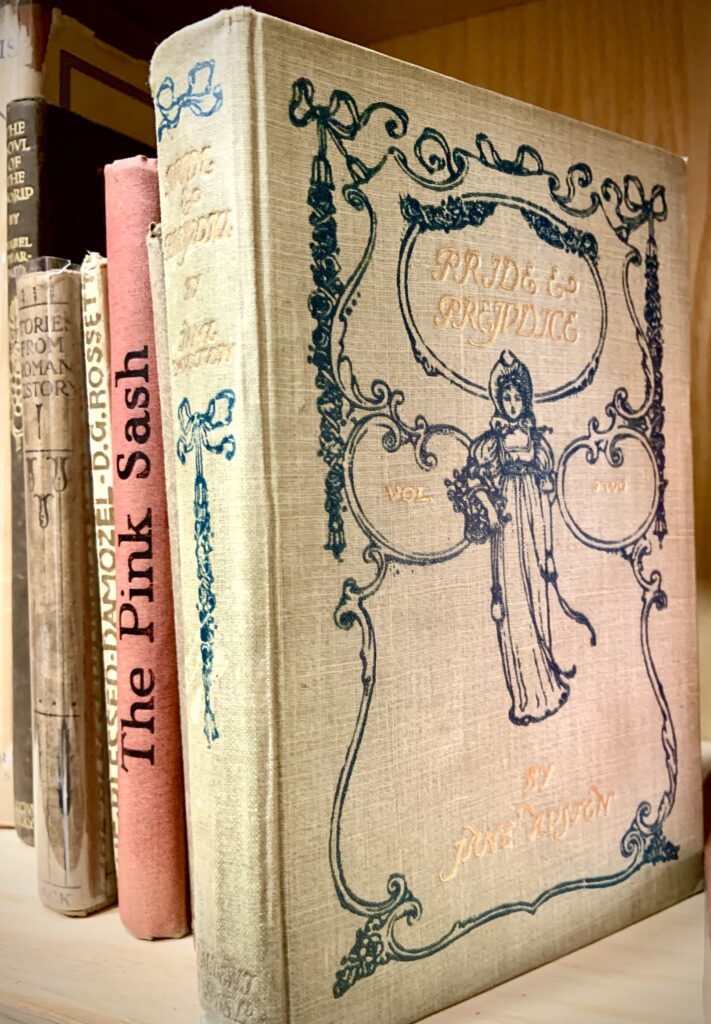
Court Barn holds an extensive collection of books with end-papers and covers decorated with Woodroffe’s patterns and illustrations. Unlike Ashbee’s Essex House Press which favoured more obscure literary titles, the Woodroffe collection was directed at the general public and includes works many of us would recognise including Nursery Tales Told to the Children, Jane Austen’s Pride and Prejudice and works by William Shakespeare. Composer Joseph Moorat, Woodroffe’s brother-in-law and his next door neighbour in Westington, arranged a book of musical nursery rhymes for which Woodroffe illustrated every page.
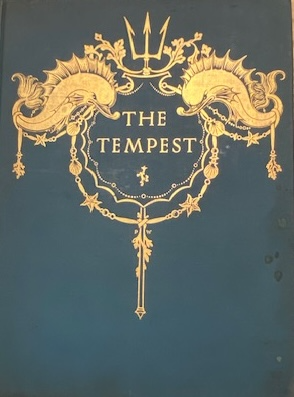
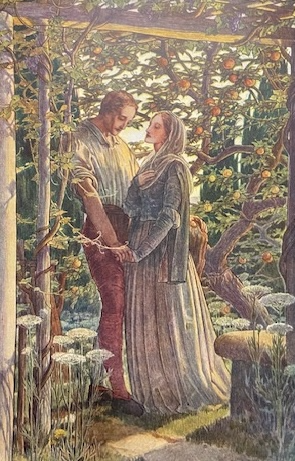
The Tempest was published in 1908 by Chapman and Hall Limited, with cover design and colour illustrations by Paul Woodroffe also featured songs by Joseph Moorat.
Born in 1875 Madras, India, Paul Woodroffe was the son of a judge. He was educated in England and studied at the Slade School of Fine Art and became a pupil of Christopher Whall, the leading Arts and Crafts painter of stained glass. Under Whall’s tutelage Woodroffe made rapid progress in acquiring the specialist skills associated with the craft. In 1901 he was elected a member of the Art Workers’ Guild and later became a member of the British Society of Master Glass Painters.