
by Penny Nuttall
When CR Ashbee moved the Guild of Handicraft to Chipping Campden in 1902, he brought with him a bindery. This bindery employed 4 people, Annie (Anastasia/Statia) Power, Nellie Binning, Lottie Eatley and Edgar Green. All are listed as Bookbinders in Ashbee’s book ‘Craftsmanship in Competitive Industry’ (Ashbee, p. 258) however not as Guildsmen but as those who served their apprenticeship or worked their time in the Guild shops without taking up full membership.

Rosary Cottage, Chipping Campden housed the Essex House Press bindary
Annie Power was the Head of the bindery but what the other three bookbinders undertook I haven’t been able to find out, probably all aspects of book production. Annie herself had trained with Douglas Cockerell for a few months (Tidcombe, p. 164) and being the head of such an enterprise, although unusual for women in these times, was becoming more common. (Tidcombe, p. 19-20 & Callen, p.197) A prospectus of 1902 for a book “The Flower and the Leaf” published by the Essex House Press noted “The Guild desires to call the attention of … to the Essex House Bindery now opened under Mr Ashbee’s direction, and in the charge of Miss Power in conjunction with the Press at Campden, Gloucestershire.”
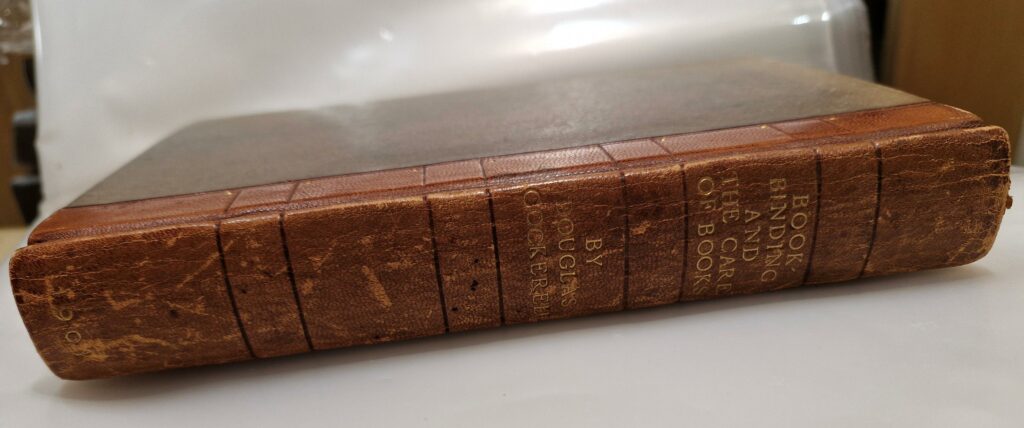
Bookbinding and the Care of Books by Douglas Cockerell, 1902
It also noted the range of binding available, designs specially prepared using various leathers, with ebony, rose and holly woods as well as silver with enamels. (Callen, p. 197) These boards were carved by Alec Miller, a Guildsman in Campden. (Tidcombe, p. 168) The bindery itself only lasted until 1905 when Annie Power married and moved away. (Callen, p. 197 & Tidcombe, p. 168)
For this article I have used two main books Anthea Callen’s Women in the Arts and Crafts movement: 1870-1914, published in 1979 and Marianne Tidcombe’s Women Bookbinders 1880-1920 published in 1996. The twenty years between them shows how much research on women’s employment history had moved on, and there is probably more since 1996.
But this is a general overview of bookbinding by women around the time of the Arts and Crafts movement. Employment for women has always been challenging. The division of labour was based on gender and class biases, with work deemed appropriate only in traditional feminine skills such as sewing and drawing. Skills involving strength, creativity, and making significant money were considered masculine. A women’s place was in the home. Nevertheless, women have found ways to overcome the restrictions of gender and class out of necessity, due to husbands passing away, or having no brothers or father to support them and their families, or sheer determination.
According to Callen up to the 16th century women had always taken on active roles in the printing trades, wives and daughters helping the master printer (Callen, p.180). Sometimes they took on the role of master when husbands died but from the 16th century women found they were increasingly excluded from apprenticeships and this made it hard to gain the necessary skills for the trade. In the 1630s young printers even protested at women in the printing trades. So by the mid-17th century, women were mainly excluded from the trade.
In the 19th century the only way for women to be part of the printing/book trades was to set up their own presses. And in 1859 the Society for Promoting the Employment of Women organised the Victoria Press, a business run by women and trained by the Society of Compositors (Callen, p. 180). But in the dying years of the 19th century formal education and training were still denied to women and Callen goes into great detail of a case of complaint brought by a Miss L. Wilkinson who had tried to enrol on a bookbinding course at the Central School of Arts and Crafts but was refused on account of her gender. In her complaint she was supported by Millicent Fawcett, a campaigner for women’s rights. But the complaint was ultimately dismissed as the strong male dominated trade unions were against the inclusion of women. (Callen, p. 190-191)
Katharine Adams decorative binding
For Tidcombe the 17th century did include women who worked in bookbinding and some were even named. (Tidcombe, p. 12) In the 1870s some upper class women began to be interested in the Arts and Crafts movement and these women began to learn and execute various skills that had been traditionally the preserve of men, and this included bookbinding and not just the sewing, folding and gathering of book production they had always been a part of but the artistic design of covers, gold leaf and binding. (Tidcombe, p. 19)
Gold leaf decoration by Katharine Adams
T. J. Cobden-Sanderson, originally a barrister, learnt the bookbinding craft and thought there was no reason for women not to do the same. He gave lectures in 1888, 1889 and 1894 on this subject, inspiring one Sarah Prideaux to take up bookbinding, one of the first women bookbinders of this time. (Tidcombe, p. 21) Another local Gloucestershire bookbinder, generally regarded as one of the best known and finest woman bookbinders of this time was Katherine Adams (1862-1952). She trained with Sarah Prideaux and also T. J. Coben-Sanderson around 1897, setting up her own bindery in Lechlade and then Eadburgha, Gloucestershire and always took on women apprentices. She was born in Bracknell but the family moved to Gloucestershire and as a child her playmates were Jenny and May Morris (William and Jane’s daughters). Katherine also exhibited in Europe, North America and South Africa and her work is to be found in libraries, museums and private collections in this country and abroad. Binding all her life, Katherine achieved about 300 bindings.
Bookbinding was a popular craft among women of the upper and middle classes, along with embroidery and illustration. As it was a home based activity and amateur in nature, it was not supposed to be in competition with skilled men. The necessity of working for a living was not a consideration for them either unlike working class women, and tuition was affordable from skilled men. This brought opportunities for these women to become skilled in the craft and to earn their own living.

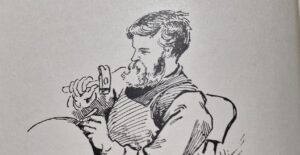
Illustration from Bookbinding and the Care of Books by Douglas Cockerell, 1902
Despite this not everybody welcomed women into the workforce and indeed C.R. Ashbee was not a fan. Many felt as these women sold their wares at prices much lower than the equivalent done by men this would have a bad effect on the family income. Ashbee wrote in his diaries about this situation “In the Guild’s workshops our fellows are rightly nervous of this competition of the amateur, especially the lady amateur …. she is versatile …. a hundred different graceful and delicate crafts …. but she is perpetually tingling to sell her work before she half knows how to make it” (Callen, p. 26 & Tidcombe, p. 27) And yet Ashbee employed a woman, Annie Power, to be in charge of the bindery in the Guild of Handicraft, but then he designed many of the books.
However bookbinding was not only a craft of fine bindings, papers and gold leaf. Book production in the 19th century was gradually becoming mechanised but it still needed labour. As more books were being produced, from the penny dreadful to the Everyman library of books, so labour was needed in all aspects of production and again gender divided the skills of employment. Working class women worked in the sewing (a female skill), folding and gathering areas of production and men worked in the designing, printing and artistic aspects of book production.

By loading the video, you agree to YouTube’s privacy policy.
Learn more
It was hard to find sources on the everyday aspect of bookbinding in the late 19th and early 20th centuries. I did though find a lovely quote in an American book on this very topic. In the introduction of “Women in the bookbinding trade” written by Mary van Kleeck in 1913, she writes “Many books have been written on bookbinding as a craft but not one has been found which contains facts regarding conditions of employment” (van Kleeck, p.4). This book was based on a study done in 1908-09 to1910-11, organised and published by the Russell Sage Foundation where Ms van Kleeck was the Social Science Researcher and was involved with the Foundation from 1909 to 1948. She was a well-known Social Scientist, reformer, feminist and social worker, nationally as well as internationally. The Russell Sage Foundation was set up by Margaret Sage in the name of her late husband in 1907; its aim was “the improvement of social and living conditions in the United States” and was involved in social research then and indeed still is today. (https://www.russellsage.org/).
Although it is an American study of women in the bookbinding trade, I believe parallels can be drawn with the trade in England especially perhaps London and other cities. It looked at 201 women workers in Manhattan in the bookbinding industry. From the 1900 census (van Kleeck, p. 2-3) there were more than 15,000 women in this and allied trades across the United States and 26% of those women were in New York City (van Kleeck, p.3). Except for large groups of women in the garment industry, bookbinding ranks second to cigar making in New York City, unusually with roughly equal numbers of men and women, and using traditional methods alongside new inventions of machinery. This study looked at all aspects of women working in this trade – 10% of whom were aged 16 and under. Conditions generally were not good although it was noted that some employers were better than others. For those who left school early there was no encouragement of industrial education for advancement as there was for men. For learners, supervision in the workroom was often missing and it was recommended that there was no employment of children under 16. Production was so subdivided as to be very dull work indeed with standing all day, carrying heavy loads (paper/books) and work hours were long with no rest periods and wages low – $7.22 a week or in 1905 noted as $6.13 in a census study of 1900.
For women came extra duties at home with house duties and child care after a long day (van Kleeck, p.223-224). The study had many recommendations; amongst them were more planning for work – it could be very seasonal with work ceasing for some periods (some employers did plan and spread work carefully), working no more than 8 hours a day, more adequate lighting, ventilation, fire protection and good wages. For women too, separate toilets and dressing rooms – often there were only general toilets and only coat hooks in a corner to change into work clothes. Personal safety was also a concern, then as now – long hours meant travelling to and from work, perhaps alone. (van Kleeck, p.231).
The type of women skilled in the craft of bookbinding waned around 1914 with the beginning of the First World War necessitating a change of focus for women. The needs of war (nursing, home front activities) diverted women’s attention to more pressing skills. But even after this women in bookbinding never went away again.
References
Ashbee, C. R., Craftsmanship in competitive industry, Guild of Handicraft Record, 1908. (appendix V)
Callen, Anthea, Women in the arts and crafts movement: 1870-1914, Astragal Books, 1980.
Tidcombe, Marianne, Women bookbinders 1880-1920, Oak Knoll Press, 1996.
Van Kleeck, Mary, Women in the bookbinding trade. Russell Sage Foundation, 1913.
Further reading
Women pioneers of the arts and crafts movement, edited by Karen Livingstone, 2024. Thames & Hudson/V&A
You may also be interested in other blogs Inspirational Women behind the Guild, Herstory Janet Ashbee, Invisible women